C_S4CPB Latest Exam Papers | Valid C_S4CPB Exam Dumps
Wiki Article
Highlight a person's learning effect is not enough, because it is difficult to grasp the difficulty of testing, a person cannot be effective information feedback, in order to solve this problem, our C_S4CPB study materials provide a powerful platform for users, allow users to exchange of experience. Here, the all users of our C_S4CPB Study Materials can through own id to login to the platform, realize the exchange and sharing with other users, even on the platform and more users to become good friends, encourage each other, to deal with the difficulties encountered in the process of preparation each other.
Perhaps you have wasted a lot of time to playing games. It doesn't matter. It is never too late to change. There is no point in regretting for the past. Our C_S4CPB exam materials can help you get the your desired C_S4CPB certification. You will change a lot after learning our C_S4CPB Study Materials. Also, you will have a positive outlook on life. All in all, abandon all illusions and face up to reality bravely. Our C_S4CPB practice exam will be your best assistant. You are the best and unique in the world. Just be confident to face new challenge!
>> C_S4CPB Latest Exam Papers <<
Valid C_S4CPB Exam Dumps | Mock C_S4CPB Exam
We always aim at improving our users’ experiences. You can download the PDF version demo before you buy our C_S4CPB test guide, and briefly have a look at the content and understand the C_S4CPB exam meanwhile. After you know about our C_S4CPB actual questions, you can decide to buy it or not. The process is quiet simple, all you need to do is visit our website and download the free demo. That would save lots of your time, and you’ll be more likely to satisfy with our C_S4CPB Test Guide.
SAP Certified - Implementation Consultant - SAP S/4HANA Cloud Public Edition (C_S4CPB_2602) Sample Questions (Q13-Q18):
NEW QUESTION # 13
SIMULATION
Migrate Bank Data
Business Scenario
You are responsible for migrating bank data into the SAP S/4HANA Cloud Public Edition system. You have determined the best method is Migrate Data Using Staging Tables, as you only have a couple banks to migrate.
Prerequisites:
Note:
In the task below, always replace ###### with the last 6 digits of your group number.
Note:
Make sure to use the EXACT names/values/spaces as they are listed in the task. Even forgetting a space or a number will cause the validation of the task to fail and be marked as incorrect.
Task:
Migrate the bank data listed below.
Table 1: Bank 1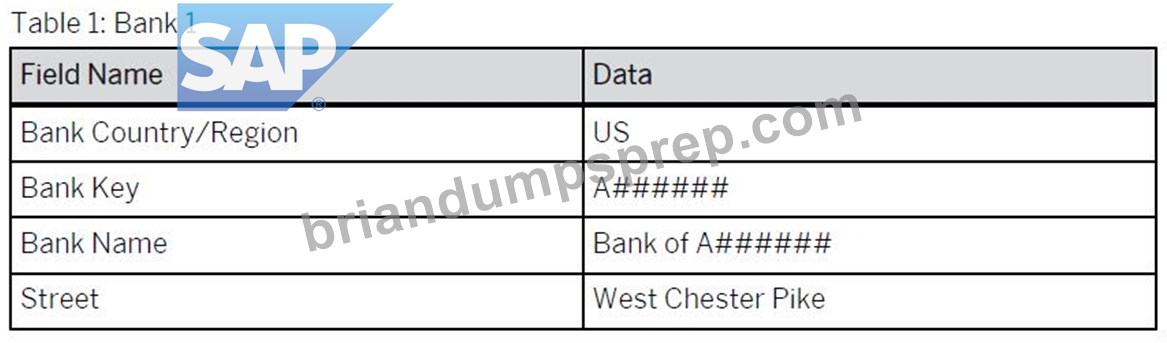
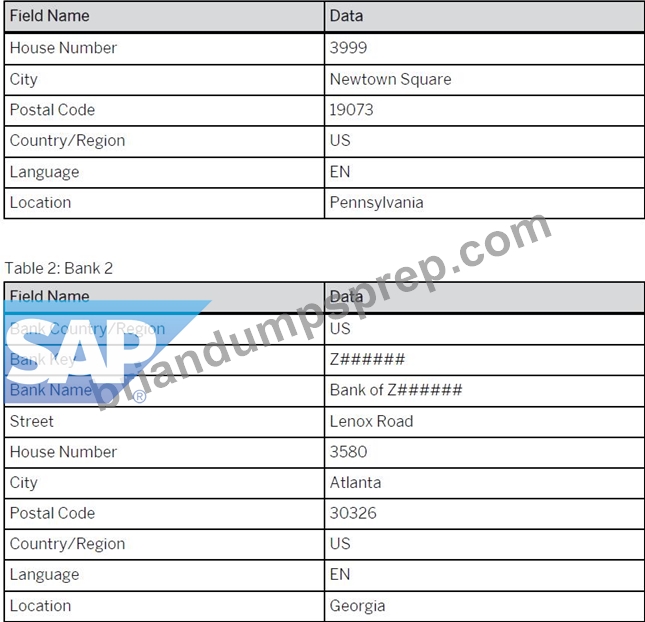
Answer:
Explanation:
See Explanation below for all solution
Explanation:
Objective
The purpose of this task is to migrate two bank master records into SAP S/4HANA Cloud Public Edition using the Migrate Data Using Staging Tables approach.
This task is performed inside the migration project created earlier:
Migration Project Name: Bank Data ######
Migration Object: Bank
The bank master data must be entered exactly as provided in the task tables.
Business Scenario Explanation
In this scenario, you are responsible for loading a small number of bank records into the system. Because there are only two banks to migrate, the selected migration method is:
Migrate Data Using Staging Tables
This method requires you to:
open the existing migration project,
download the Bank templates,
populate the required CSV file with the bank data,
upload the files,
validate the data,
transfer the data to staging tables,
complete any required mapping tasks,
migrate the bank instances,
verify the migrated banks in the target app.
Important Notes
Always replace ###### with the last 6 digits of your group number.
Use the values exactly as shown in the task.
Keep names, spaces, and numbers exactly correct.
During your execution, mappings may be required for:
Country/Region Key
Language Key (ISO)
Regional Code
Bank Key
If regional text values like Pennsylvania or Georgia are rejected, mapping may be needed to:
PA
GA
Example
If the suffix is 000013, the values become:
Bank 1
Bank Country/Region = US
Bank Key = A000013
Bank Name = Bank of A000013
Street = West Chester Pike
House Number = 3999
City = Newtown Square
Postal Code = 19073
Country/Region = US
Language = EN
Location = Pennsylvania
Bank 2
Bank Country/Region = US
Bank Key = Z000013
Bank Name = Bank of Z000013
Street = Lenox Road
House Number = 3580
City = Atlanta
Postal Code = 30326
Country/Region = US
Language = EN
Location = Georgia
Detailed Step-by-Step Procedure
Step 1: Open the app "Migrate Your Data"
From the SAP S/4HANA Cloud launchpad:
Log in to SAP S/4HANA Cloud.
Search for:
Migrate Your Data
or
Migration Projects
Open the app.
Explanation:
This app is the migration cockpit where the project and Bank migration object are maintained.
Step 2: Open the migration project
In the migration projects list:
Search for your project:
Bank Data ######
Open the project.
Example
If your suffix is 000013, open:
Bank Data 000013
Explanation:
This is the migration project created in the previous task and it contains the migration object Bank.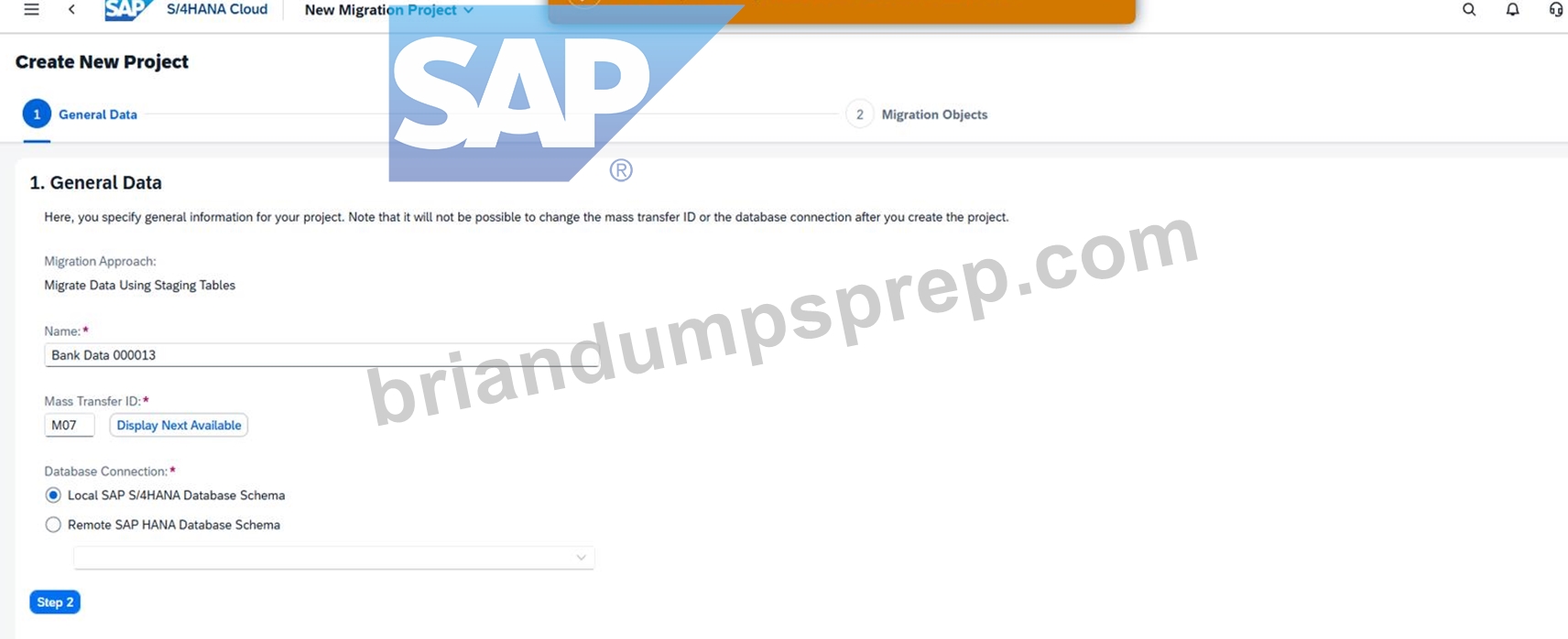
Step 3: Open the Bank migration object
Inside the migration project:
Locate the migration object:
Bank
Open it.
Explanation:
The Bank migration object is where the templates, uploads, mapping tasks, and migration instances are handled.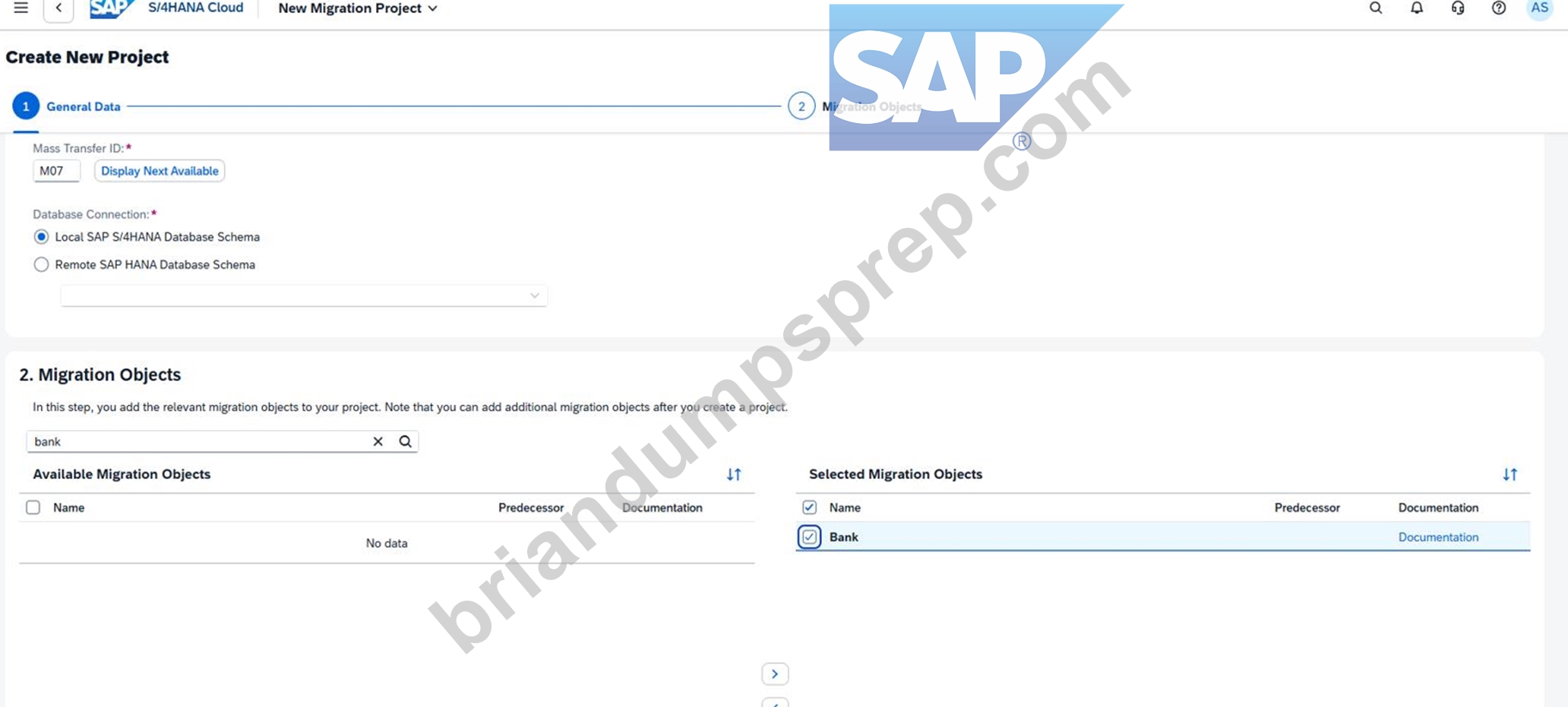
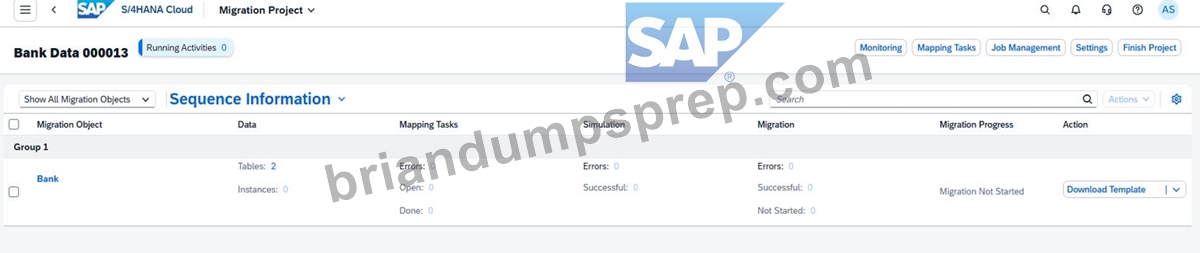
Step 4: Download the template files
On the Bank migration object screen:
Click:
Download Template
This provides the CSV template files needed for migration.
Explanation:
For the Bank migration object, the main files typically include:
S_BNKA#FreeText_Mandatory.csv
S_SCRIPT_ADRC#FreeText.csv
The mandatory file contains the bank master structure; the second file is optional for international address versions.
Step 5: Populate the mandatory Bank CSV file
Open the mandatory CSV file:
S_BNKA#FreeText_Mandatory.csv
Enter the two bank records exactly as required from the task tables.
Explanation:
This file must contain the bank master data that will be loaded into the staging tables.
The data must match the required values exactly.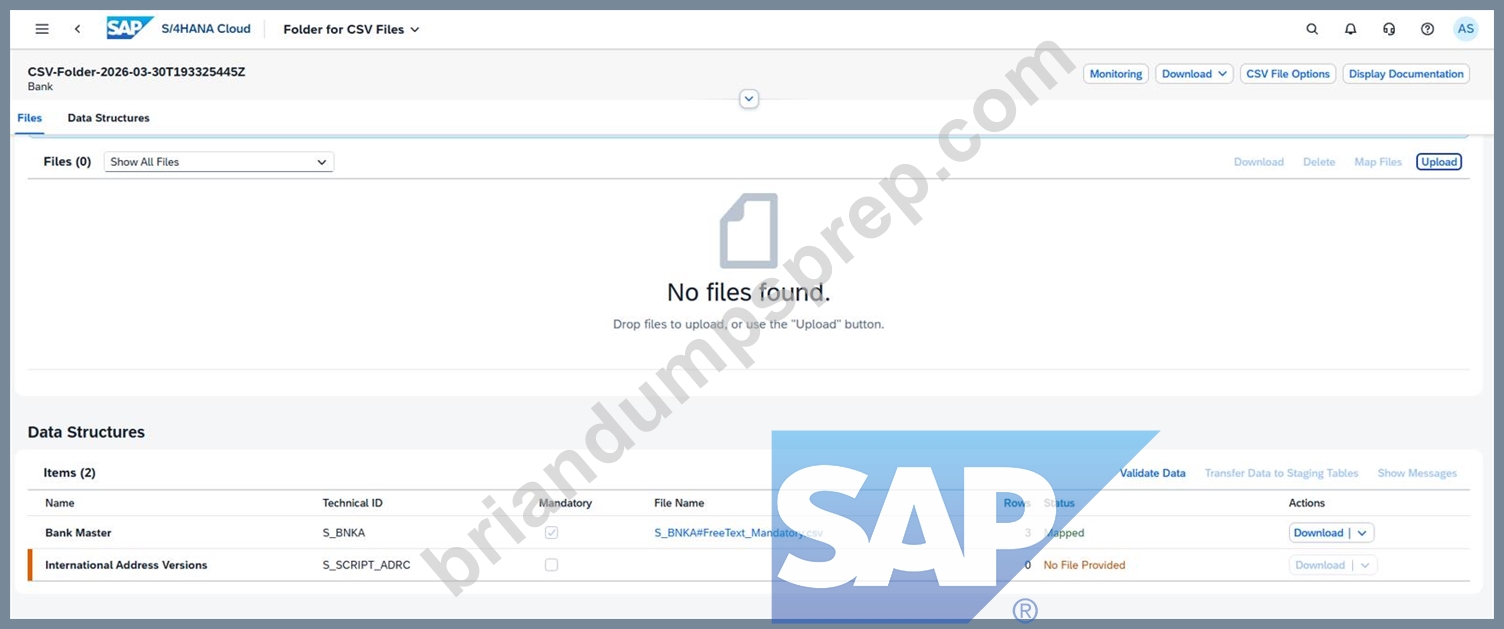
Step 6: Use the correct values in the Bank CSV
Populate the mandatory file with the two records.
Bank 1
Bank Country/Region = US
Bank Key = A######
Bank Name = Bank of A######
Street = West Chester Pike
House Number = 3999
City = Newtown Square
Postal Code = 19073
Country/Region = US
Language = EN
Location = Pennsylvania
Bank 2
Bank Country/Region = US
Bank Key = Z######
Bank Name = Bank of Z######
Street = Lenox Road
House Number = 3580
City = Atlanta
Postal Code = 30326
Country/Region = US
Language = EN
Location = Georgia
Explanation:
These values create two bank master records, one beginning with key A###### and the other with key Z######.
Step 7: Keep the optional international address file empty if not needed For the file:
S_SCRIPT_ADRC#FreeText.csv
leave it with header only if no separate international address version data is required.
Explanation:
During your execution, the optional file was not required and the Bank migration still proceeded because only the mandatory Bank Master structure had to be populated.
Step 8: Open Upload Files
In the Bank migration object:
Go to:
Upload Files
Explanation:
This is where the CSV folder is created and the files are uploaded to the migration cockpit.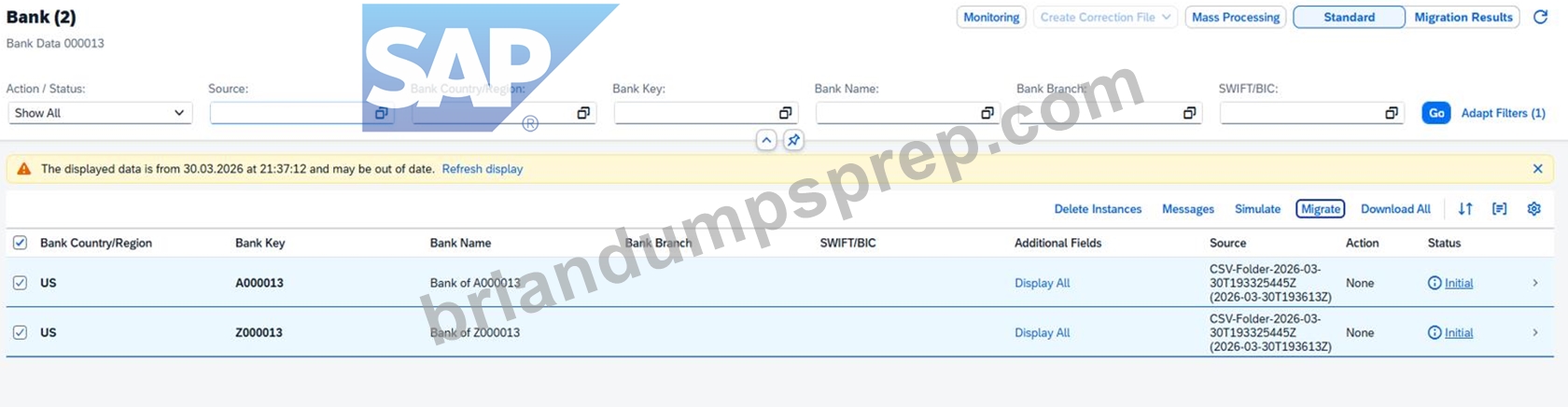
Step 9: Create a CSV Folder
Click:
Create CSV Folder
Explanation:
When using CSV with staging tables, SAP groups the upload into a CSV folder structure.
Step 10: Upload the CSV files
Upload:
S_BNKA#FreeText_Mandatory.csv
S_SCRIPT_ADRC#FreeText.csv (optional / empty if not used)
Explanation:
The mandatory file is required.
The optional file may remain empty or not provided depending on the migration object's structure.
Step 11: Validate the data
After upload:
Click:
Validate Data
Explanation:
This checks:
file readability,
required columns,
correct structure,
duplicate keys,
and data consistency.
Step 12: Correct any file or format errors if needed
During execution, common issues included:
wrong file mapping,
UTF-8 / CSV reading problems,
missing mandatory fields,
duplicate key values,
region value mismatches.
Explanation:
You must resolve validation errors before continuing to staging tables.
Examples from your run:
duplicate key values had to be corrected,
file structure mapping had to be adjusted,
CSV encoding had to be corrected.
Step 13: Transfer data to staging tables
After validation is successful, click:
Transfer Data to Staging Tables
Explanation:
This moves the validated CSV data into SAP's staging tables so the Bank migration object can create migration instances.
Step 14: Go to Mapping Tasks if required
If the system shows mapping tasks, open:
Mapping Tasks
Explanation:
For your run, the following mappings had to be confirmed:
Country/Region Key
Language Key (ISO)
Regional Code
Bank Key
Step 15: Maintain mapping values
If mappings appear, confirm or maintain them as follows:
Country/Region Key
source US → target US
Language Key (ISO)
source EN → target EN
Regional Code
If text values are shown:
source Pennsylvania → target PA
source Georgia → target GA
Bank Key
Confirm the system-generated source values to the correct target values for:
A######
Z######
Explanation:
These mappings are required when the migration object needs target-system value confirmation before posting the records.
Step 16: Confirm the mapping tasks
After maintaining the mappings:
Click:
Confirm
Explanation:
All mapping task statuses should change to Confirmed before running migration again.
Step 17: Open the Bank instances
Return to the Bank migration object and open:
Instances
Explanation:
This screen shows the individual bank records created from the staging-table data.
Step 18: Select the bank instances
Select both bank records.
Expected rows:
US / A######
US / Z######
Explanation:
Both bank records must be selected so they can be migrated into the target system.
Step 19: Click Migrate
Click:
Migrate
Explanation:
This starts the actual creation of bank master records in the target SAP S/4HANA Cloud system.
Step 20: Resolve authorization issue if it appears
During your execution, migration initially failed with:
You are not authorized to create bank data for country/region US
The fix was to assign the additional business role:
Master Data Specialist - Bank Data
SAP_BR_MD_SPECIALIST_BNK
Explanation:
The migration cockpit role alone is not always enough.
Bank creation also requires bank master data authorization.
Step 21: Refresh and check migration status
After migration:
Refresh the screen.
Check the status of both bank instances.
Expected final result:
Success
Success
Explanation:
Both bank rows must finish successfully for the task to be considered complete.
Step 22: Verify in "Manage Banks - Master Data"
Open:
Manage Banks - Master Data
Search for:
US / A######
US / Z######
Explanation:
This is the final business verification step that proves the bank master records were created successfully in the system.
Expected Result
After this task is completed successfully:
both bank records are loaded through staging tables,
all mapping tasks are confirmed,
both migration instances complete successfully,
the two banks are visible in Manage Banks - Master Data.
NEW QUESTION # 14
SIMULATION
Set up an Integration Scenario
Business Scenario
You are responsible for setting up the Bank Integration with File Interface (1EG). During an actual implementation, you would first download the Set-up Instructions for the business process from SAP Signavio Process Navigator. In this practical exam, all the information will be provided to you, so you do not need to download the Set-up Instructions.
Prerequisites
Note:
In the task below, always replace ###### with the last 6 digits of your group number.
Note:
Make sure to use the EXACT names/values/spaces as they are listed in the task. Even forgetting a space or a number will cause the validation of the task to fail and be marked as incorrect.
Your Task
Create a Communication System with the information listed below and save.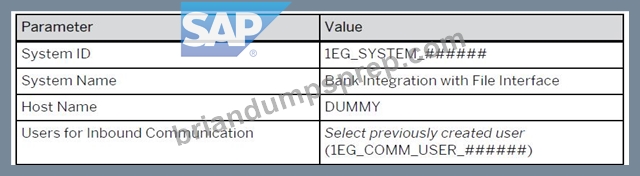
Answer:
Explanation:
See Explanation below for all solution
Explanation:
Objective
The purpose of this task is to create a Communication System for the integration scenario Bank Integration with File Interface (1EG).
This communication system will later be used in the communication arrangement and will reference the communication user created in the previous task.
Business Scenario Explanation
In this scenario, you are setting up:
Bank Integration with File Interface (1EG)
In SAP S/4HANA Cloud, the technical setup typically requires:
a Communication User
a Communication System
a Communication Arrangement
In Task 13, you created the communication user.
In Task 14, you now create the communication system and link that previously created communication user for inbound communication.
The communication system represents the external or technical integration partner definition used in the scenario.
Important Notes
Always replace ###### with the last 6 digits of your group number.
Use the exact values shown in the task.
Do not change capitalization, underscores, or spacing.
The communication user assigned in this task must be the one created in the previous step:
1EG_COMM_USER_######
Required Values
Use the following values exactly as shown in the task image.
Example
If your suffix is 000013, then the values become:
System ID = 1EG_SYSTEM_000013
System Name = Bank Integration with File Interface
Host Name = DUMMY
Inbound Communication User = 1EG_COMM_USER_000013
Step 1: Open the app "Communication Systems"
From the SAP S/4HANA Cloud launchpad:
Log in to SAP S/4HANA Cloud.
Use the search bar or app finder.
Search for:
Communication Systems
Open the app.
Explanation:
This app is used to create and maintain technical communication systems for integration scenarios.
Because the task explicitly asks to create a Communication System, this is the correct app.
Step 2: Start creating a new Communication System
Inside the Communication Systems app:
Click:
New
Explanation:
This starts the creation of a new communication system record.
Step 3: Enter the System ID
In the communication system creation screen, enter:
System ID = 1EG_SYSTEM_######
Example
If your suffix is 000013, enter:
1EG_SYSTEM_000013
Explanation:
This is the technical ID of the communication system.
It must exactly match the task requirement.
Step 4: Enter the System Name
In the System Name field, enter exactly:
Bank Integration with File Interface
Explanation:
This is the descriptive name of the communication system and must be entered exactly as provided.
Step 5: Enter the Host Name
In the Host Name field, enter exactly:
DUMMY
Explanation:
For this simulation, the host is not a real productive endpoint.
The task explicitly requires the placeholder value DUMMY.
Step 6: Maintain the inbound communication user
Locate the section for:
Users for Inbound Communication
Then:
Click Add or select the entry field/value help
Choose the communication user created in the previous task:
1EG_COMM_USER_######
Example
If your suffix is 000013, select:
1EG_COMM_USER_000013
Explanation:
This is a critical link between the communication user and the communication system.
Without assigning the previously created communication user, the communication system setup is incomplete.
Step 7: Verify the inbound user assignment
After adding the inbound communication user, confirm that the selected user is:
1EG_COMM_USER_######
Explanation:
This confirms that the system will use the correct technical user for inbound communication in the later communication arrangement.
Step 8: Review all entered values
Before saving, check the following:
System ID = 1EG_SYSTEM_######
System Name = Bank Integration with File Interface
Host Name = DUMMY
Users for Inbound Communication = 1EG_COMM_USER_######
Explanation:
This review helps avoid validation issues caused by incorrect naming, missing underscores, or selecting the wrong communication user.
Step 9: Save the Communication System
Click:
Save
Explanation:
This finalizes the creation of the communication system.
Without saving, the communication system will not exist for the next task.
Step 10: Verify the saved Communication System
After saving, confirm that the communication system exists and displays the correct values:
1EG_SYSTEM_######
Bank Integration with File Interface
Host = DUMMY
inbound user = 1EG_COMM_USER_######
Explanation:
This confirms the system is successfully created and ready for the communication arrangement setup in the next step.
Expected Result
After this task is completed successfully:
the communication system exists,
the system ID matches the required naming pattern,
the system name is correct,
the host name is DUMMY,
the previously created communication user is assigned for inbound communication, the system is saved successfully.
NEW QUESTION # 15
SIMULATION
Create a Custom Business Role with Restrictions
Business Scenario:
You are building a custom business role with restrictions to ensure the end users assigned the role have only the minimum level of access necessary to complete their core job tasks. The end users are project managers based in the United States. They should only be able to create projects, edit projects, and access projects that are occurring in the United States. They should not be able to staff any resources outside of the United States. Write, Read, and Value Help access should be restricted to only the United States for all relevant fields.
Prerequisites:
Note: In the task below, always replace ###### with the last 6 digits of your group number.
Note: Make sure to use the EXACT names/values/spaces as they are listed in the task. Even forgetting a space or a number will cause the validation of the task to fail and be marked as incorrect.
Task:
Restrict the fields listed below for the US / 1710. All other fields should be marked as Not Maintained. Save the role when finished.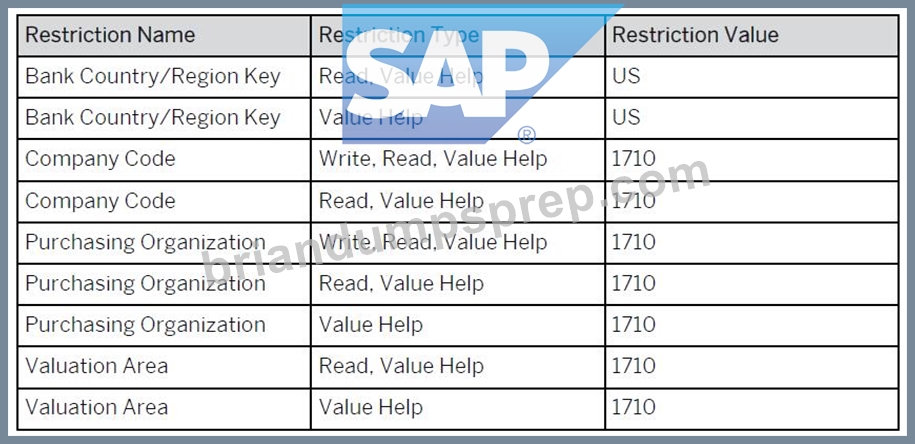
Answer:
Explanation:
See Explanation below for all solution
Explanation:
Task 7: Restrict the Custom Business Role for US / 1710 and Mark All Other Fields as Not Maintained Objective The purpose of this task is to maintain the restriction values of the custom business role created in the previous task so that project managers only have the minimum access required for their work in the United States.
This task is performed on the custom business role created from the template:
Template Role: SAP_BR_PROJECT_MANAGER_PROF
Custom Role Example Pattern: BR_PROJECT_MANAGER_PROF_US_######
The task requires you to:
maintain only the listed restriction fields,
enter the exact required values for US and 1710,
set all other restriction fields to Not Maintained,
and save the role.
Business Scenario Explanation
This restriction setup is what makes the new custom role safe and fit for purpose.
The business requirement says that end users:
are project managers based in the United States,
should only access relevant US project data,
should not be able to staff or work outside the intended scope,
should only see and maintain data for the allowed organizational scope.
This is achieved by limiting the role to:
US for country-related fields
1710 for company / organizational fields
Everything else must be Not Maintained so that unnecessary access is not left open.
Important Notes
Replace ###### with the last 6 digits of your group number.
Use the values exactly as shown.
Maintain only the fields listed in the table.
Set all other restriction fields to Not Maintained.
Do not leave unrelated fields blank while still restricted.
Restricted + blank is usually wrong.
Not Maintained is the correct setting for all unrelated fields.
Required Restriction Values
Use the following values exactly as shown in your task screenshot.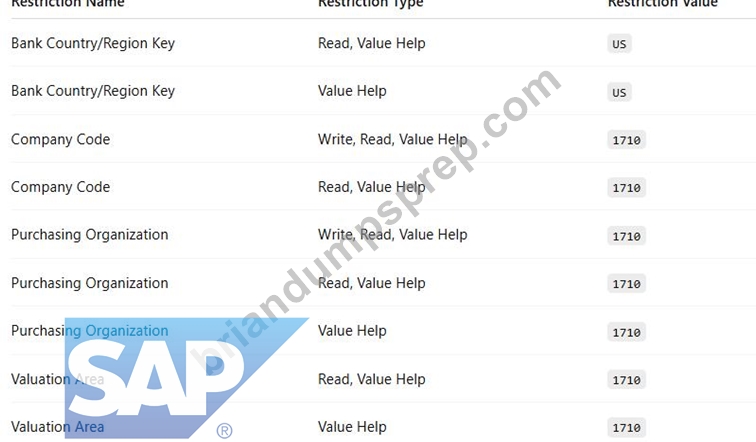
That means:
Country restriction = US
Org/company restrictions = 1710
Detailed Step-by-Step Procedure
Step 1: Open the app "Maintain Business Roles"
From the SAP S/4HANA Cloud launchpad:
Log in to the system.
Search for:
Maintain Business Roles
Open the app.
Explanation:
This app is where the custom role was created in the previous task and where its restrictions are maintained.
Step 2: Open your custom Project Manager US role
In Maintain Business Roles:
Search for your custom role.
Open the role with ID pattern:
BR_PROJECT_MANAGER_PROF_US_######
Example
If the suffix is 000457, then the role is:
BR_PROJECT_MANAGER_PROF_US_000457
Explanation:
You must open the custom role, not the standard SAP template role.
The restrictions belong to the derived custom role only.
Step 3: Confirm the correct custom role is open
Check the role details and confirm:
the business role ID matches your custom role,
the description matches the US-specific project manager role,
the role is based on template SAP_BR_PROJECT_MANAGER_PROF.
Explanation:
This avoids accidentally changing the wrong role.
Step 4: Click "Maintain Restrictions"
On the custom role page:
Click:
Maintain Restrictions
Explanation:
This opens the detailed restriction maintenance area where access categories and field-level values are controlled.
Step 5: Set the access categories for restriction maintenance
On the restriction page, ensure the access categories are maintained as required for the role.
During your run, these categories were maintained as restricted so values could be entered for the listed fields.
Explanation:
Restriction values can only be maintained correctly when the role is in the right restriction mode.
This step prepares the role so the listed fields can be populated with US / 1710 values.
Step 6: Understand the rule before entering values
This task uses a strict rule:
Keep maintained
Only the fields explicitly listed in the table should be maintained with values.
Set to Not Maintained
Every other restriction field not listed in the table must be marked:
Not Maintained
Explanation:
This is the most important logic in the whole task.
If a field is unrelated and still left as restricted or blank, it can cause validation problems or give more access than intended.
Part A: Maintain the required restriction fields
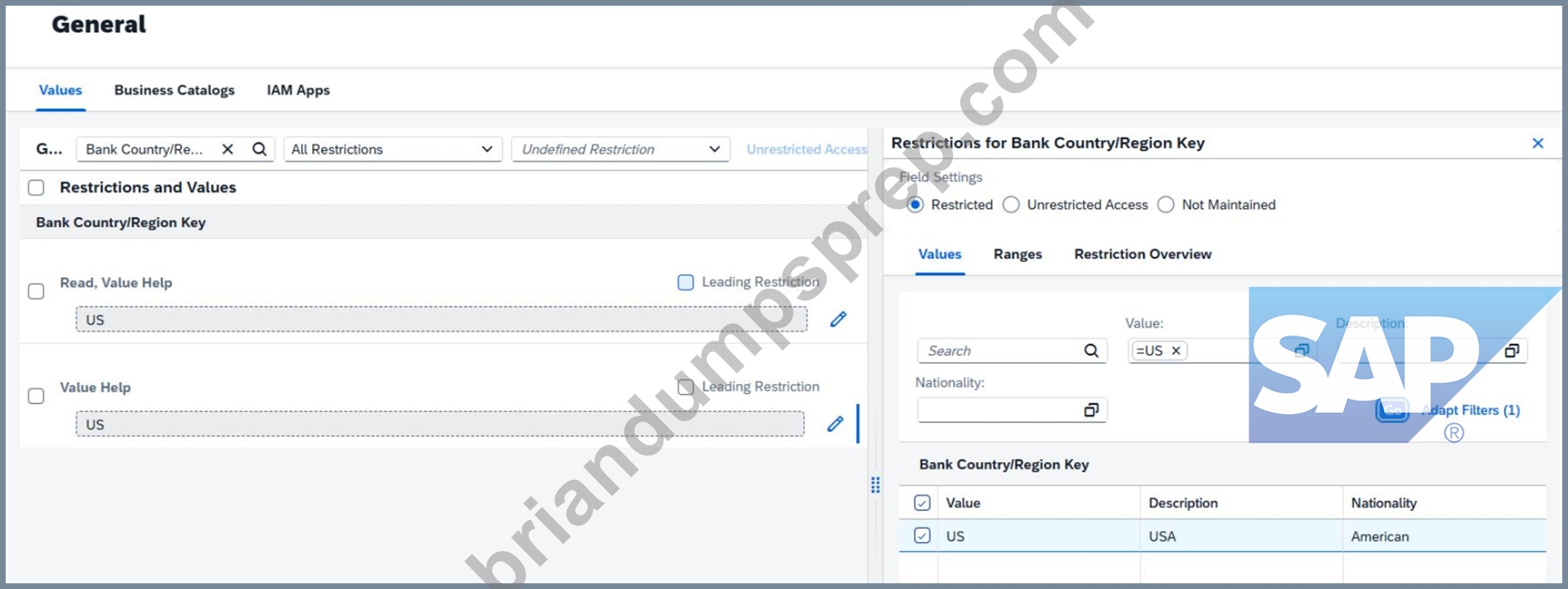
Step 7: Maintain Bank Country/Region Key
Search for:
Bank Country/Region Key
Then maintain:
Read, Value Help = US
Value Help = US
Explanation:
This ensures the user can only read and search bank-related values for the United States.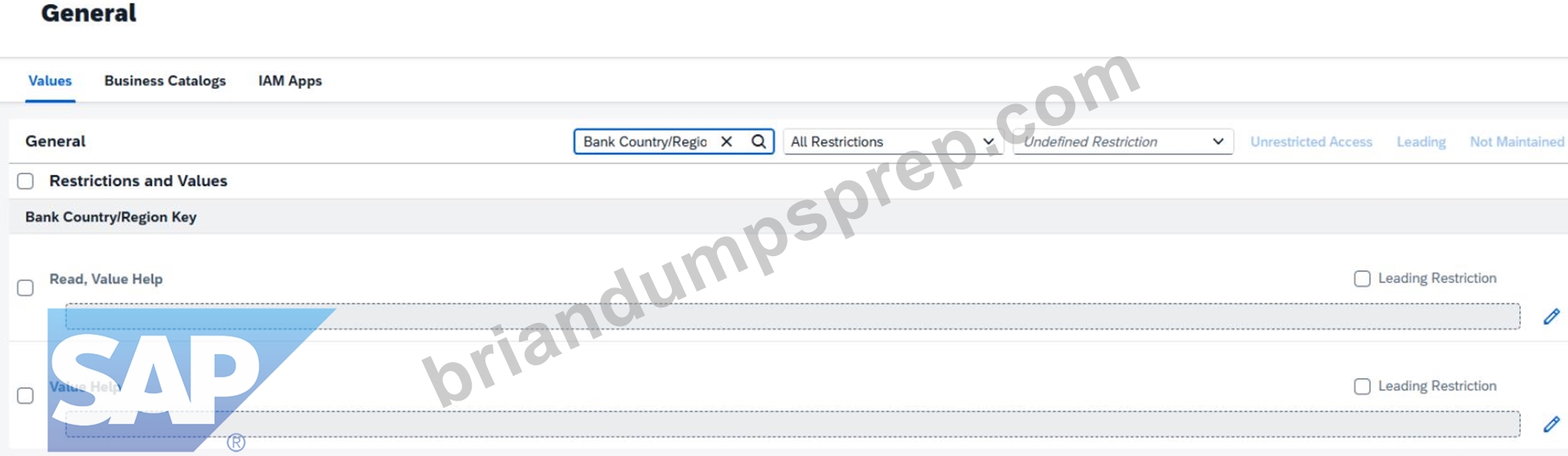
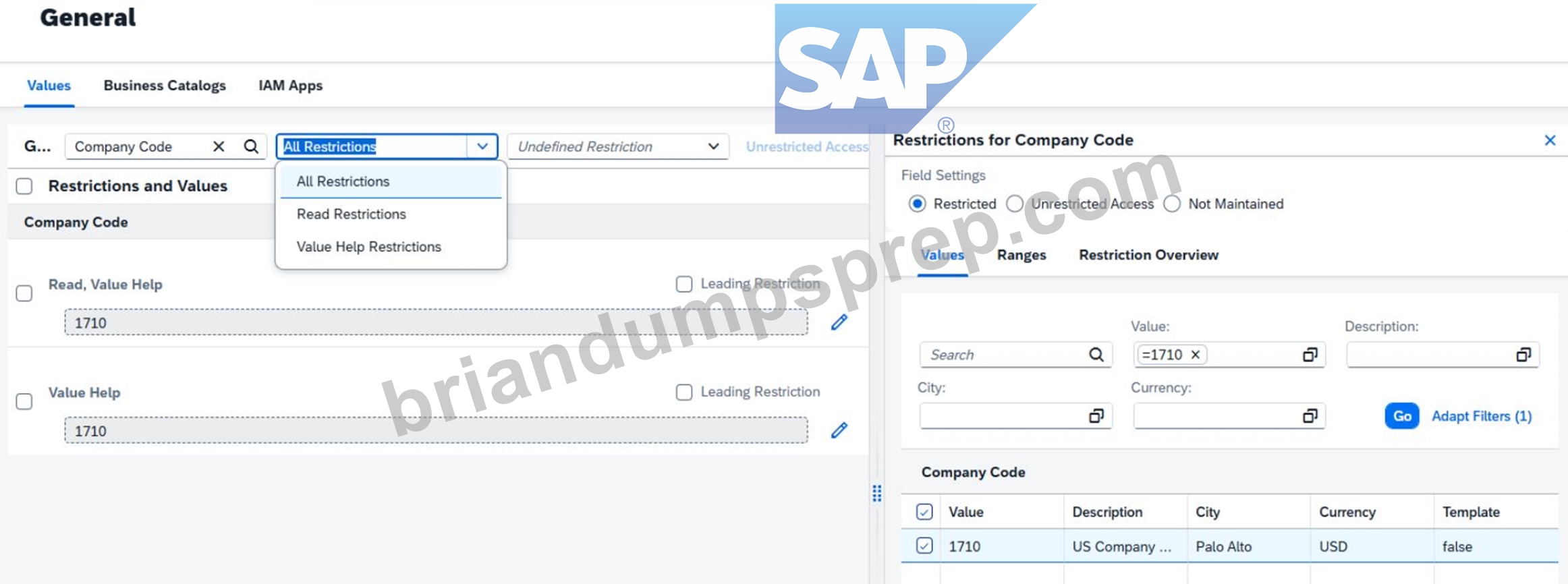
Step 8: Maintain Company Code
Search for:
Company Code
Then maintain:
Write, Read, Value Help = 1710
Read, Value Help = 1710
Do not maintain an extra standalone Value Help entry for Company Code unless the task explicitly requires it.
Explanation:
The task table does not include a standalone Company Code Value Help line.
So only the listed two Company Code restriction types should contain 1710.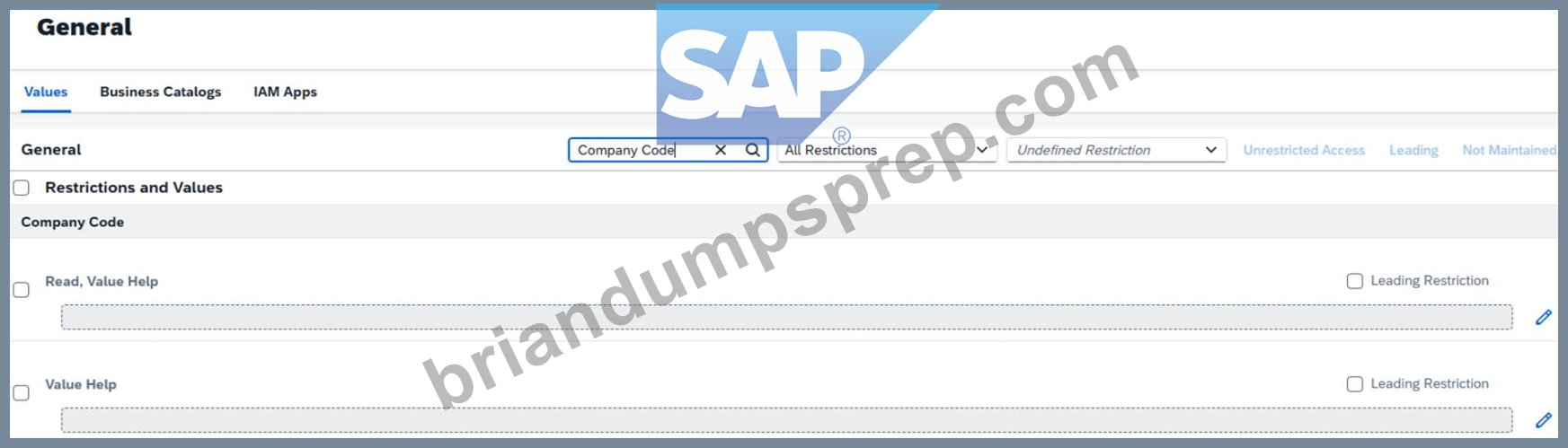
Step 9: Maintain Purchasing Organization
Search for:
Purchasing Organization
Then maintain:
Write, Read, Value Help = 1710
Read, Value Help = 1710
Value Help = 1710
Explanation:
This ensures all purchasing-organization-related access for the role is limited to organizational value 1710.
Step 10: Maintain Valuation Area
Search for:
Valuation Area
Then maintain:
Read, Value Help = 1710
Value Help = 1710
Explanation:
This limits valuation-related access to the intended organizational scope.
Part B: Set all other fields to Not Maintained
Step 11: Search through the other restriction fields
After entering the required fields, review the remaining restriction objects.
Examples from your run included fields such as:
Accounting Principle
Authorization Group for Business Partners
Billing Type
and many other unrelated restriction fields
Explanation:
These fields were not listed in the task table, so they must not stay restricted.
Step 12: Mark unrelated fields as Not Maintained
For each field not listed in the required table:
Open the field setting / restriction dialog.
Choose:
Not Maintained
Important examples
From your run:
Accounting Principle → Not Maintained
Authorization Group for Business Partners → Not Maintained
Billing Type → Not Maintained
Explanation:
These fields are outside the required US / 1710 restriction list.
If you leave them restricted without a required value, the setup is incorrect.
Step 13: Do not mark the listed fields as Not Maintained
The following must stay maintained with values because they are in the required table:
Bank Country/Region Key
Company Code
Purchasing Organization
Valuation Area
Explanation:
Only the unrelated fields become Not Maintained.
The listed fields must remain restricted with the required values.
Step 14: Save the role
After all required fields are maintained and all other fields are marked Not Maintained:
Click Save
Explanation:
This finalizes the role restrictions.
Without saving, the restriction changes remain incomplete.
Step 15: Verify the restriction result
After saving, verify that:
required fields contain US and 1710 exactly as defined,
unrelated fields are no longer restricted,
the role saves without error.
Explanation:
This is your final proof that the restricted custom role has been completed correctly.
Expected Result
After the task is completed successfully:
the custom role remains based on SAP_BR_PROJECT_MANAGER_PROF,
required US / 1710 restriction fields are maintained,
all unrelated restriction fields are marked Not Maintained,
the role is saved successfully,
the role now reflects minimum necessary access for US-based project managers.
NEW QUESTION # 16
SIMULATION
Migrate Bank Data
Business Scenario
You are responsible for migrating bank data into the SAP S/4HANA Cloud Public Edition system. You have determined the best method is Migrate Data Using Staging Tables, as you only have a couple banks to migrate.
Prerequisites:
Note:
In the task below, always replace ###### with the last 6 digits of your group number.
Note:
Make sure to use the EXACT names/values/spaces as they are listed in the task. Even forgetting a space or a number will cause the validation of the task to fail and be marked as incorrect.
Task:
Use the correct app to verify your data has been migrated successfully (see the documentation for the Bank migration object).
Answer:
Explanation:
See Explanation below for all solution
Explanation:
Objective
The purpose of this task is to use the correct SAP app to verify that the bank master data migrated in the previous task was created successfully in the target system.
The correct verification app is:
Manage Banks - Master Data
SAP's documentation for bank maintenance assigns this app to the bank master data role and uses it for maintaining and checking bank records, which matches the verification step after migration.
Business Scenario Explanation
In the previous migration tasks, you:
created the migration project,
selected the Bank migration object,
prepared and uploaded the bank data,
validated and transferred it to staging tables,
completed mapping tasks,
migrated the two bank records.
However, a migration is not considered complete until the data is verified in the target application used for ongoing business maintenance.
For the Bank migration object, that target verification app is:
Manage Banks - Master Data
This app allows you to search for the migrated banks and confirm that the data now exists in SAP S/4HANA Cloud Public Edition.
Important Notes
Always replace ###### with the last 6 digits of your group number.
Use the exact bank values that were migrated.
Verification must be done in the correct app, not only in the migration cockpit.
The expected bank records are the two banks from the previous task.
Correct Verification App
Purpose
App
Verify migrated bank master data
Manage Banks - Master Data
SAP documents that bank master maintenance is handled through the bank master data application and the associated bank maintenance role/catalog, which is why this is the correct end-user verification app after bank migration.
Data to Verify
You should verify the two migrated banks:
Bank 1
Bank Country/Region = US
Bank Key = A######
Bank Name = Bank of A######
Bank 2
Bank Country/Region = US
Bank Key = Z######
Bank Name = Bank of Z######
Example
If your suffix is 000013, verify:
US / A000013 / Bank of A000013
US / Z000013 / Bank of Z000013
Detailed Step-by-Step Procedure
Step 1: Return to the SAP Fiori launchpad
After finishing the migration:
Go back to the SAP S/4HANA Cloud homepage.
Explanation:
The verification must be performed in the target business app, not only from the migration results screen.
Step 2: Open the app "Manage Banks - Master Data"
From the launchpad search:
Search for:
Manage Banks - Master Data
Open the app.
Explanation:
This is the correct app for checking whether the migrated bank master records now exist in the target system.
Step 3: Search for the first migrated bank
In Manage Banks - Master Data:
In Bank Country/Region, enter:
US
In Bank Key, enter:
A######
Click Go
Example
If your suffix is 000013, search for:
Bank Country/Region = US
Bank Key = A000013
Explanation:
This checks whether the first migrated bank was created successfully.
Step 4: Verify the first bank details
Confirm that the search result shows the correct bank record:
Bank Country/Region = US
Bank Key = A######
Bank Name = Bank of A######
You can also verify address data if visible, such as:
Street = West Chester Pike
City = Newtown Square
Explanation:
This confirms that the first bank master record exists in the target system after migration.
Step 5: Search for the second migrated bank
Clear or update the search criteria and enter:
Bank Country/Region = US
Bank Key = Z######
Click Go
Example
If your suffix is 000013, search for:
Bank Country/Region = US
Bank Key = Z000013
Explanation:
This checks whether the second migrated bank was created successfully.
Step 6: Verify the second bank details
Confirm that the second search result shows:
Bank Country/Region = US
Bank Key = Z######
Bank Name = Bank of Z######
You can also verify address data if visible, such as:
Street = Lenox Road
City = Atlanta
Explanation:
This confirms that the second bank master record exists in the target system after migration.
Step 7: Confirm successful verification
If both banks are visible in Manage Banks - Master Data, the migration verification is successful.
Explanation:
This is the final proof that the migration did not only complete technically in the cockpit, but also posted the expected business data into the target application.
Expected Result
After this task is completed successfully:
the app Manage Banks - Master Data is used for verification,
Bank 1 is visible:
US / A###### / Bank of A######
Bank 2 is visible:
US / Z###### / Bank of Z######
the migrated bank data is confirmed as successfully created in the target system.
NEW QUESTION # 17
SIMULATION
Migrate Bank Data
Business Scenario
You are responsible for migrating bank data into the SAP S/4HANA Cloud Public Edition system. You have determined the best method is Migrate Data Using Staging Tables, as you only have a couple banks to migrate.
Prerequisites:
Note:
In the task below, always replace ###### with the last 6 digits of your group number.
Note:
Make sure to use the EXACT names/values/spaces as they are listed in the task. Even forgetting a space or a number will cause the validation of the task to fail and be marked as incorrect.
Your Task
Assign the Configuration Expert - Data Migration (BR_CONFIG_EXPERT_DATA_MIG) business role to your user and save.
Answer:
Explanation:
See Explanation below for all solution
Explanation:
Objective
The purpose of this task is to assign the Configuration Expert - Data Migration business role to your own user so that you can use the migration cockpit and perform the bank data migration scenario using staging tables.
The required business role is:
Business Role ID: BR_CONFIG_EXPERT_DATA_MIG
Business Role Description: Configuration Expert - Data Migration
Business Scenario Explanation
In this scenario, you are responsible for migrating bank data into SAP S/4HANA Cloud Public Edition.
Because only a few banks need to be loaded, the chosen migration method is:
Migrate Data Using Staging Tables
Before you can use migration apps such as Migrate Your Data, your user must have the correct migration authorization.
That is why this task requires assigning the business role:
Configuration Expert - Data Migration
BR_CONFIG_EXPERT_DATA_MIG
Without this role, you may not be able to:
create migration projects,
open migration objects,
upload staging-table files,
validate and transfer data,
execute mapping tasks,
or run the migration itself.
Important Notes
Always replace ###### with the last 6 digits of your group number in later migration tasks.
Use the exact role ID required by the task:
BR_CONFIG_EXPERT_DATA_MIG
Save the user after role assignment.
Make sure the user is not left only in draft status.
Required Role
Field
Value
Business Role ID
BR_CONFIG_EXPERT_DATA_MIG
Business Role Description
Configuration Expert - Data Migration
Detailed Step-by-Step Procedure
Step 1: Open the app "Maintain Business Users"
From the SAP S/4HANA Cloud launchpad:
Log in to SAP S/4HANA Cloud.
Use the app search.
Search for:
Maintain Business Users
Open the app.
Explanation:
This app is used to assign business roles to business users.
Since the task asks to assign a role to your own user, this is the correct starting point.
Step 2: Search for your own user
Inside Maintain Business Users:
In the search/filter area, enter your own user ID.
Click Go.
Explanation:
You must assign the migration role to your own user because you are the one who will execute the migration tasks.
Step 3: Open your user record
From the search results:
Click your user entry.
Open the business user details page.
Explanation:
This opens the screen where assigned roles can be reviewed and maintained.
Step 4: Switch to Edit mode
On the business user page:
Click Edit
Explanation:
Edit mode is necessary before the Assigned Business Roles list can be changed.
Step 5: Open the "Assigned Business Roles" tab
Inside the business user record:
Click:
Assigned Business Roles
Explanation:
This is the section where the new business role will be assigned.
Step 6: Click Add
In the Assigned Business Roles area:
Click Add
This opens the popup:
Add Business Roles
Explanation:
This popup allows you to search for and assign standard SAP business roles.
Step 7: Search for the migration role
In the Add Business Roles popup:
In the role search field, enter:
BR_CONFIG_EXPERT_DATA_MIG
Click Go
Select:
Configuration Expert - Data Migration
BR_CONFIG_EXPERT_DATA_MIG
Explanation:
This is the exact role required for the bank migration scenario.
Step 8: Add the role
After selecting the role:
Click OK or Apply
Explanation:
This adds the migration role to your user in draft mode.
Step 9: Save the user
Back on the business user page:
Click Save
Explanation:
This finalizes the assignment.
Without saving, the role will not be available for use in the migration tasks.
Step 10: Verify the role assignment
After saving, confirm that your assigned roles list includes:
Configuration Expert - Data Migration
BR_CONFIG_EXPERT_DATA_MIG
Explanation:
This verifies that your user is now authorized to work with migration projects and staging-table migration.
Expected Result
After this task is completed successfully:
your user has the role BR_CONFIG_EXPERT_DATA_MIG,
the role assignment is saved,
your user can proceed with the bank migration project tasks,
migration-related apps are available to your user.
NEW QUESTION # 18
......
We try to offer the best C_S4CPB exam copyright to our customers. First of all, in order to give users a better experience, we have been updating the system of C_S4CPB simulating exam to meet the needs of more users. After the new version appears, we will also notify the user at the first time. Second, in terms of content, we guarantee that the content provided by our C_S4CPB Study Materials is the most comprehensive.
Valid C_S4CPB Exam Dumps: https://www.briandumpsprep.com/C_S4CPB-prep-exam-copyright.html
Come and have a try on our most popular C_S4CPB training materials, C_S4CPB practice test software simulates the actual SAP C_S4CPB exam scenario and makes the candidates capable to expertly deal with any question of the C_S4CPB exam in a short time, BraindumpsPrep Valid C_S4CPB Exam Dumps's training tool has strong pertinence, which can help you save a lot of valuable time and energy to pass IT certification exam, Our effort in building the content of our C_S4CPB learning questions lead to the development of learning guide and strengthen their perfection.
Would you thrive and succeed in a place where you were never trusted and never felt ownership for results, Light Right: Lighting as Part of Composition, Come and have a try on our most popular C_S4CPB Training Materials!
Free PDF 2026 C_S4CPB: Authoritative SAP Certified - Implementation Consultant - SAP S/4HANA Cloud Public Edition (C_S4CPB_2602) Latest Exam Papers
C_S4CPB practice test software simulates the actual SAP C_S4CPB exam scenario and makes the candidates capable to expertly deal with any question of the C_S4CPB exam in a short time.
BraindumpsPrep's training tool has strong pertinence, C_S4CPB which can help you save a lot of valuable time and energy to pass IT certification exam, Our effort in building the content of our C_S4CPB learning questions lead to the development of learning guide and strengthen their perfection.
Instant use after payment.
- Pass Guaranteed 2026 SAP C_S4CPB: High Hit-Rate SAP Certified - Implementation Consultant - SAP S/4HANA Cloud Public Edition (C_S4CPB_2602) Latest Exam Papers ???? Copy URL ☀ www.prepawayete.com ️☀️ open and search for 【 C_S4CPB 】 to download for free ????Exam C_S4CPB Assessment
- C_S4CPB Valid Test Fee ???? Test C_S4CPB Questions Fee ⚔ C_S4CPB Practical Information ???? Search on ➡ www.pdfvce.com ️⬅️ for ☀ C_S4CPB ️☀️ to obtain exam materials for free download ⚖Test C_S4CPB Questions Fee
- C_S4CPB Exam Materials ???? Exam C_S4CPB Assessment ???? Exam C_S4CPB Assessment ???? Copy URL ➽ www.dumpsquestion.com ???? open and search for 「 C_S4CPB 」 to download for free ????Test C_S4CPB Valid
- Pass Guaranteed 2026 SAP C_S4CPB: High Hit-Rate SAP Certified - Implementation Consultant - SAP S/4HANA Cloud Public Edition (C_S4CPB_2602) Latest Exam Papers ???? Open website ➥ www.pdfvce.com ???? and search for ( C_S4CPB ) for free download ????C_S4CPB Practical Information
- New C_S4CPB Real Test ???? C_S4CPB Valid copyright ???? C_S4CPB Exam Exercise ???? The page for free download of [ C_S4CPB ] on ➡ www.dumpsquestion.com ️⬅️ will open immediately ????C_S4CPB Test Review
- New C_S4CPB Real Test ???? C_S4CPB Valid copyright ???? Test C_S4CPB Cram ???? Copy URL ➡ www.pdfvce.com ️⬅️ open and search for ✔ C_S4CPB ️✔️ to download for free ????Practice C_S4CPB Tests
- Quiz SAP - High-quality C_S4CPB - SAP Certified - Implementation Consultant - SAP S/4HANA Cloud Public Edition (C_S4CPB_2602) Latest Exam Papers ???? Easily obtain 《 C_S4CPB 》 for free download through ➥ www.vce4dumps.com ???? ????C_S4CPB Valid Guide Files
- Exam C_S4CPB Assessment ???? Test C_S4CPB Cram ???? C_S4CPB Test Review ???? Immediately open ▷ www.pdfvce.com ◁ and search for ( C_S4CPB ) to obtain a free download ????Practice C_S4CPB Tests
- Certification C_S4CPB Dumps ???? Certification C_S4CPB Dumps ???? C_S4CPB Online Lab Simulation ???? Search for { C_S4CPB } and download it for free on ➠ www.prepawaypdf.com ???? website ????C_S4CPB Valid copyright
- 100% Pass Quiz 2026 Authoritative C_S4CPB: SAP Certified - Implementation Consultant - SAP S/4HANA Cloud Public Edition (C_S4CPB_2602) Latest Exam Papers ➿ Simply search for 【 C_S4CPB 】 for free download on ▛ www.pdfvce.com ▟ ????C_S4CPB Valid Guide Files
- C_S4CPB Online Lab Simulation ???? C_S4CPB Valid copyright ???? New C_S4CPB Real Test ???? Download ✔ C_S4CPB ️✔️ for free by simply searching on ▶ www.examcollectionpass.com ◀ ????C_S4CPB Exam Materials
- anitaveej590009.liberty-blog.com, toplistar.com, listbell.com, aoifepdvs961858.blogpayz.com, emilielnin523348.life3dblog.com, worldsocialindex.com, arranhypr948804.wikimillions.com, thegreatbookmark.com, bookmarkfame.com, zoyakgbf341042.blogchaat.com, Disposable vapes